St. Timothy's brass cross
City of GodThe St. Timothy's brass cross is the physical and symbolic heart of E. L. Doctorow's City of God, an eight-foot hollow brass crucifix that vanishes from its place behind the altar of St. Timothy's Episcopal Church and reappears, inexplicably, lying flat on the tarred roof of the Synagogue of Evolutionary Judaism on West Ninety-eighth Street. Its theft and strange relocation constitute the novel's founding mystery, the event that transforms the Reverend Thomas Pemberton from a parish priest into a self-styled detective and drives him toward a theological reckoning that ends in his abandonment of the priesthood and his conversion to Judaism. The cross is never merely a stolen object; it is a sign, a provocation, and a challenge to every assumption Pem holds about God, sacrifice, and the meaning of religious faith.
Identity and Physical Character
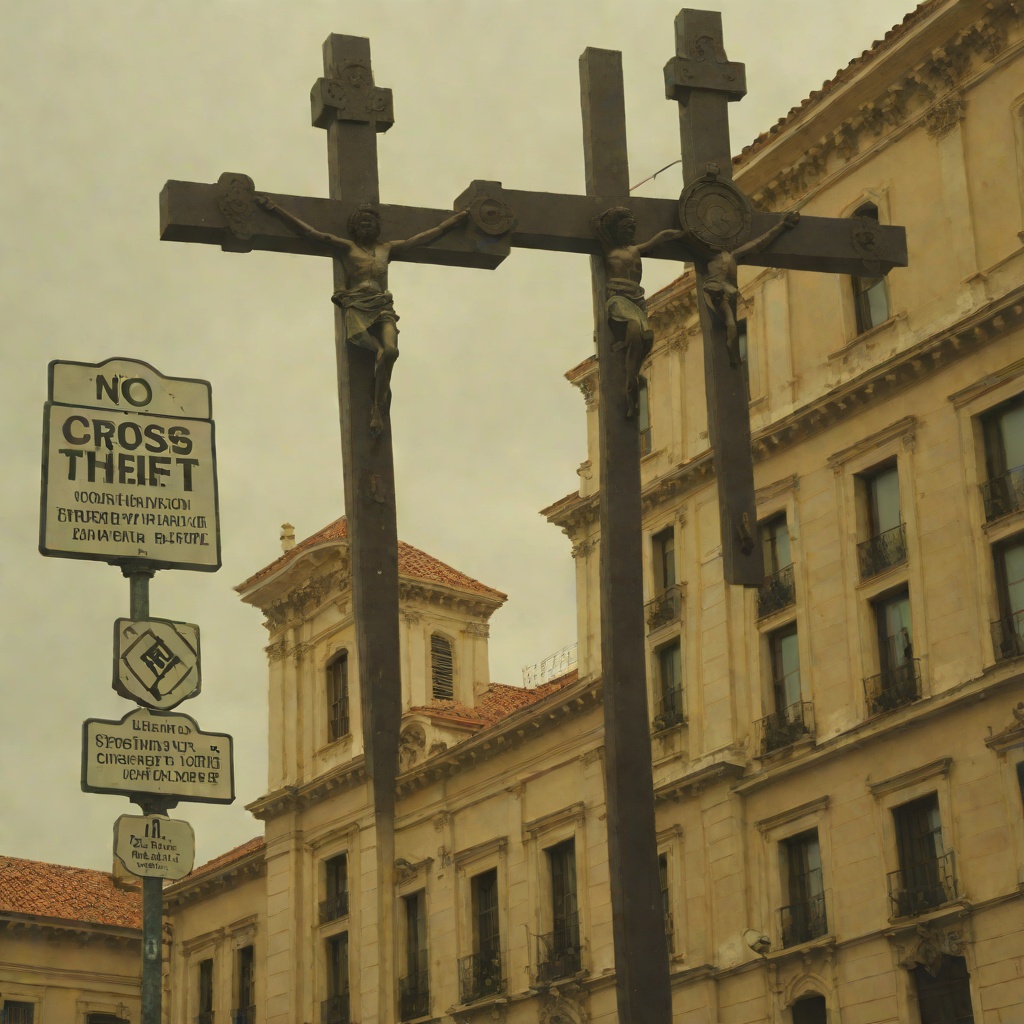
The cross is described in precise, almost forensic detail. It is eight feet high, made of hollow brass, and weighs little enough that Pem can lift it at the foot, though he notes it is "clearly too much cross to bear on the stations of the IRT." Its construction reveals that it is not all of a piece: the arms are bolted to the upright in a kind of mortise-and-tenon joint, a detail Pem discovers only after the theft when he examines it closely on the synagogue roof. The surface bears the accumulated marks of its history—"the old nicks and dents" Pem recognizes from years of familiarity, along with some new ones acquired during its removal and transport. When the detective assigned to the case dismisses its value, telling Pem that on the street it is "nothing but scrap metal" with a book value of "zilch," the cross's material worth is established as essentially nothing; its significance is entirely symbolic. The detective, a Catholic who attends mass, contrasts it with a Torah scroll, which he says would bring a minimum of five thousand dollars because it is handwritten and not a mass-produced item. The cross, by this accounting, is worthless—and yet it is precisely this worthlessness that makes its theft and relocation so baffling and so freighted with meaning.
The Theft and the Empty Wall
The cross disappears from behind the altar of St. Timothy's, and Pem's first encounter with its absence is rendered as a kind of vision. He describes swinging a searchlight beam through the darkened church and seeing "a shadow rising with distinction, something with right angles in the vanished instant of the turned corner." Running back into the church, he finds that where the big brass cross should have been, there is only "a shadow of Your crucifix, Lord, in the unfaded paint of my predecessor's poor taste"—the ghostly outline left by years of the cross hanging against the wall. The image is doubly resonant: the cross is gone, but its trace remains, a negative space that testifies to its long presence. Pem initially assumes the thieves were "crackheads looking for a few dollars," and he tells a sympathetic young reporter from The New York Times that he did not understand anything until the cross was taken. His attitude shifts remarkably quickly, however. He reflects that he is "used to being robbed," recalling how the diocese took away his food-for-the-homeless program and merged it with one across town, costing him most of his parish—"That was a big-time heist." By the end of his reflection, he has arrived at a startling reinterpretation: "whoever stole the cross had to do it. And wouldn't that be blessed? Christ going where He is needed?" The theft, which should be a violation, becomes in Pem's framing a possible act of grace.
The Discovery on the Synagogue Roof
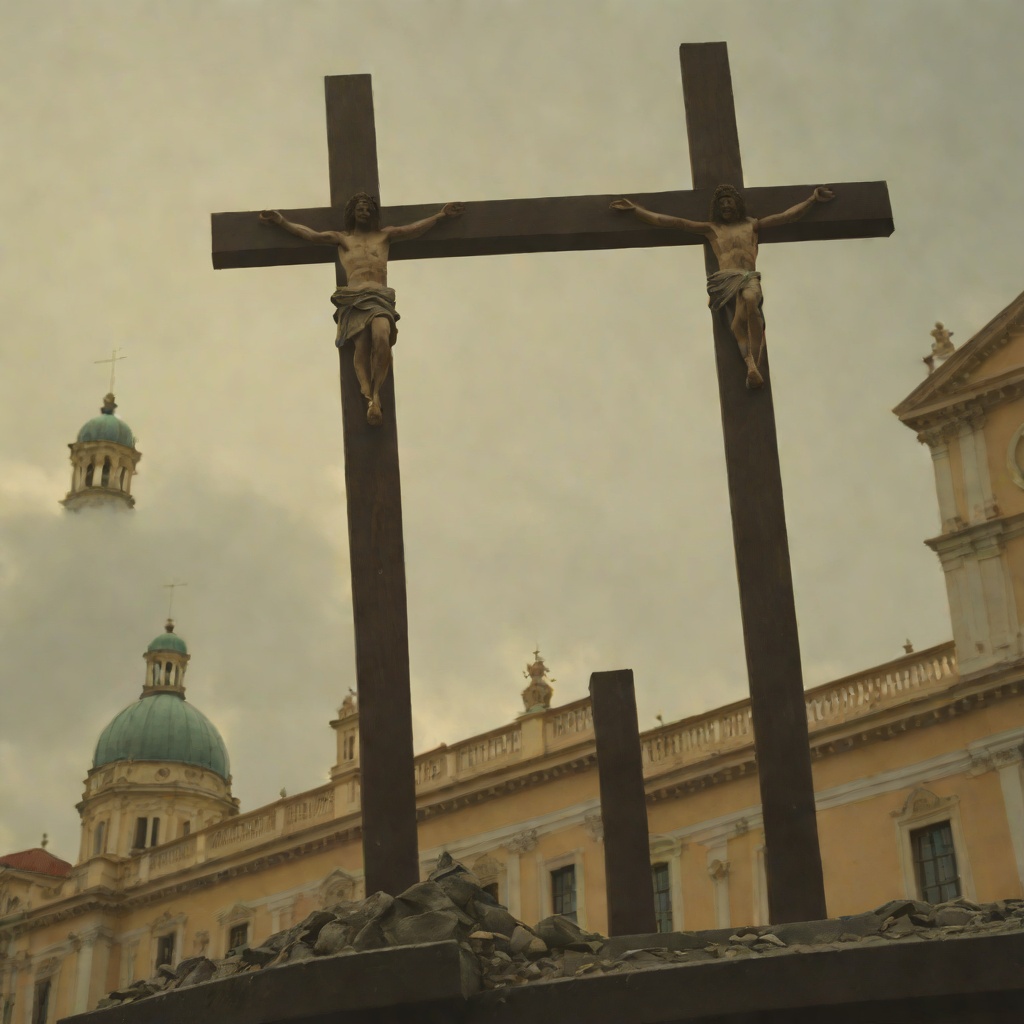
The cross's reappearance is orchestrated with the same strangeness as its disappearance. Pem receives a voice mail from Rabbi Joshua Gruen of the Synagogue of Evolutionary Judaism on West Ninety-eighth Street, who insists they meet "as soon as possible" but refuses to answer questions over the phone. When Pem arrives at the brownstone synagogue between West End and Riverside Drive, he is led through the converted parlor that serves as the sanctuary, past the Ark and the platform table for reading the Torah, up through the family's living quarters, and finally onto the flat roof via an iron ladder and a trapdoor. There, lying flat on the black tarred roof with its transverse exactly parallel to the front of the building and its upright pressed against the granite pediment, is the eight-foot hollow brass cross of St. Timothy's, "tarnished and shining in the autumn sun." The scene is charged with an almost unbearable significance: the autumn sun behind the apartment houses, the late afternoon river breeze, Pem's exhilaration and slight vertigo at roof-standing. Rabbi Gruen, his hands in his pockets, points with his chin to the Ninety-eighth Street frontage, and Pem bends down for a closer look, examining the old nicks and dents and the new ones too. When he asks how Gruen knew the cross was there, the rabbi answers that he received an anonymous phone call: "Hello, Rabbi? Your roof is burning." The cross has been placed with deliberate care, its transverse parallel to the building's front, its upright against the pediment—an arrangement that suggests intention and meaning rather than random vandalism.
The Cross as Sign and Mystery
The cross's placement on the synagogue roof transforms it from a stolen object into what Pem comes to call "the Sign." He reflects that the thieves "may not have been the mindless creeps I thought they were," and that it may not have been anti-Semites or Jewish ultras who brought it to the roof of the EJ synagogue. The question of who put it there—and why—remains unresolved, and Pem concludes that "it was an affront whoever put it there. Maybe, maybe not." The ambiguity is essential. Pem does not think of the sign as necessarily unearthly, but as "so cryptic as to render the motives of the human beings who had arranged it entirely beside the point." He feels, with what he recognizes as "the stunning power of superstition," that to discuss the sign, to speak of it, would be for it to lose its light. He must keep his own counsel, even as far as Sarah Blumenthal is concerned, waiting until he knows without question when to confide in her. The sign is "betrayable in speech, and positioned on the edge of unreason," a challenge to his behavior. He has recognized it for what it is but not for what it is instructing him to do. From the very beginning, even before the cross was stolen, the events at St. Tim's had turned him into "a detective of sorts," and he decides his life must seriously become "a truly humble, dogged act of detection." The cross thus inaugurates Pem's vocation as the "Divinity Detective," a role that will carry him through the novel's investigations into the Holocaust, the nature of evil, and the possibility of faith.
The Cross and the Theology of Sacrifice
The cross's symbolic weight is amplified by Pem's theological reflections on sacrifice and atonement. In his remarks to the bishop's examiners, he invokes the work of Burkert, "perhaps our pre-eminent scholar of ancient religions," who investigates the origins of the sacred—"itself a heretical pursuit." Burkert's picture of the lizard who leaves his tail in the mouth of the predator, the fox who chews off his foot to escape the trap, becomes for Pem a model of sacrifice: "You give up a part to save the whole." Ancient myths abound in which human beings flee monsters and escape only by sacrificing pieces of themselves to divert or slow down the pursuit; Orestes gives up a finger. This understanding of sacrifice as a programmed biological response, a strategy of self-preservation through self-mutilation, stands in stark contrast to the Christian doctrine of the cross as a voluntary atonement for sin. The stolen cross, an emblem of that doctrine, is thus interrogated by Pem's own developing theology. In his final act as a Christian and an ex-Christian priest, his wedding prayer for Thomas Pemberton and Sarah Blumenthal, he addresses God directly with devastating candor: "You are bought and embraced like the lowest, most pathetic streetwalker." The cross, which should be the supreme symbol of God's love, has become in Pem's reckoning a sign of God's complicity in human evil—"You are part of the problem." The stolen and relocated cross, stripped of its institutional setting and placed on a synagogue roof, becomes the occasion for this radical rethinking of what the crucifix means.
The Cross as Catalyst for Conversion
The cross's appearance on the synagogue roof is, for Pem, the announcement of "something momentous." He feels himself changing, working around in his thinking toward a meaningful transition, though he does not yet know to what. His conviction that the cross's appearance signals a revelation is "not a proposition he was prepared to argue with anyone," partly because it belongs to a mode of thought characteristic of ancient prophetic communications he can no longer countenance, and partly because he fears that speaking of it will diminish it. He hopes that a revelation is evolving, that it is a slow process, and that it might be manifest "even in the moans of the dying" at the hospice across the East River where he has chosen to work as "an appropriate dead end for his professional life." The cross, in other words, does not resolve Pem's crisis; it initiates it and sustains it. It is the object that refuses to be explained, that resists the detective's methods even as it demands them. Its mystery is never fully solved—the identity of the thieves, the meaning of their act, the significance of the anonymous phone call all remain open questions. What is resolved is Pem himself: the cross's inexplicable journey from Christian altar to Jewish synagogue roof mirrors and enables his own journey from the priesthood to Judaism, from a faith in a God who can be possessed to a faith in a God who cannot. The cross, which the detective said was worth nothing, turns out to be worth everything—not as an object of value, but as the occasion for a transformation that no amount of brass could purchase.